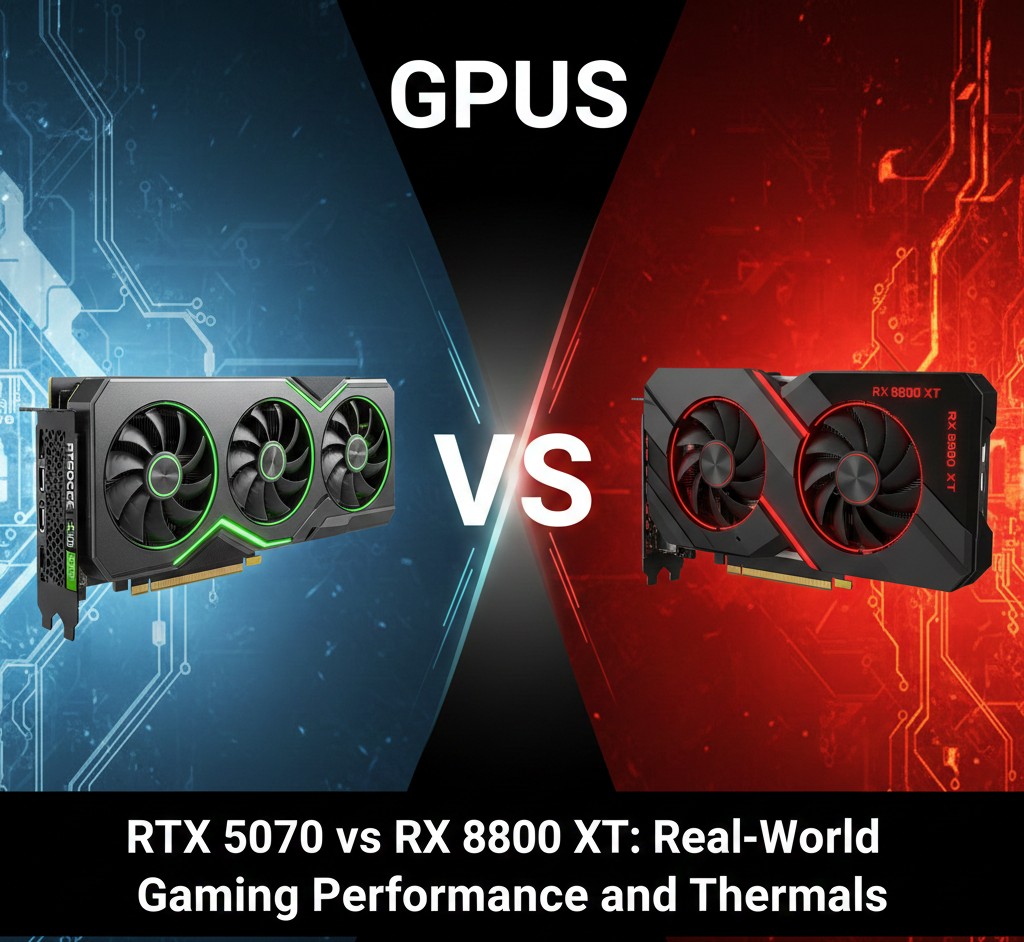
Choosing a new graphics card in 2025 isn’t just about raw specifications anymore. Real-world gaming performance, power efficiency, and thermals often matter more than synthetic benchmarks. In this comparison, we take a practical look at NVIDIA RTX 5070 and AMD RX 8800 XT, focusing on how they actually perform in modern games and how well they handle heat under load.
Gaming Performance: What Really Matters
1080p and 1440p Gaming
At 1080p, both GPUs deliver excellent performance. Most modern AAA titles easily exceed 120 FPS on high or ultra settings. Differences here are minimal and often CPU-limited.
At 1440p, the gap becomes more noticeable:
-
RTX 5070 tends to deliver smoother frame pacing, especially in games optimized for NVIDIA architectures.
-
RX 8800 XT often pushes higher raw FPS in rasterized workloads, making it very competitive for traditional gaming scenarios.
4K Gaming
For 4K gaming, both cards are capable, but compromises are required:
-
The RTX 5070 benefits from advanced upscaling technologies, allowing playable frame rates with high visual fidelity.
-
The RX 8800 XT relies more on brute force and performs well in games without heavy ray tracing.
Ray Tracing and Upscaling
Ray tracing continues to be a key differentiator:
-
RTX 5070 handles ray tracing more efficiently, maintaining better performance when effects like reflections and global illumination are enabled.
-
RX 8800 XT supports ray tracing but sees a bigger performance drop in demanding titles.
Upscaling technologies help bridge the gap:
-
NVIDIA’s solution feels more mature in real-world usage.
-
AMD’s alternative has improved significantly and works well in supported games, especially at higher resolutions.
Thermals and Power Efficiency
Cooling Performance
In extended gaming sessions:
-
RTX 5070 generally runs cooler, with most custom models staying in the low 70°C range.
-
RX 8800 XT tends to run warmer, often reaching mid to high 70°C, depending on the cooling design.
Power Consumption
Power efficiency is another important factor:
-
The RTX 5070 is noticeably more power-efficient, which translates into lower heat output and quieter operation.
-
The RX 8800 XT draws more power under load, requiring a stronger cooling solution and a higher-quality power supply.
Noise Levels
Thanks to better efficiency:
-
RTX 5070 systems are usually quieter, especially during long gaming sessions.
-
RX 8800 XT cards can become audible under heavy load, though premium models manage noise quite well.
Which One Should You Choose?
Choose RTX 5070 if:
-
You care about ray tracing performance
-
You want better thermals and lower power consumption
-
You value quieter operation and efficiency
Choose RX 8800 XT if:
-
You prioritize raw raster performance
-
You mainly play non–ray-traced games
-
You’re looking for strong performance per dollar
Final Thoughts
Both GPUs are excellent choices in 2025, and neither is a bad option. The RTX 5070 stands out with better efficiency, thermals, and ray tracing, while the RX 8800 XT delivers impressive raw gaming performance and strong value for traditional workloads.
Ultimately, the best choice depends on your gaming preferences, resolution, and how much you care about power efficiency versus maximum FPS.